
Ten years ago, two Russian nationals, Aleksandra Krylova and Anna Bogacheva, spent a month touring the United States. Their itinerary included stops across the country: New York, Louisiana, California, Colorado. But their focus was not simply a tourist’s curiosity. They were employees of a new agency that had decided to “spread distrust towards the candidates and the [American] political system in general,” as a subsequent federal indictment alleged. They were here to get a feel for how that might work.
The branch of that effort in which Krylova and Bogacheva participated — the effort to amplify disinformation and controversy on social media — had no demonstrable effect on the 2014 or 2016 elections. The other component of Russia’s 2016 effort — the release of material stolen from a senior adviser to the Democratic candidate — may have. But the Russian effort was nonetheless an enormous success, as reflected in new federal documents articulating how that ongoing effort has evolved.
On Wednesday, the Justice Department published an indictment targeting two employees of RT, the media entity controlled by the Russian government that was formerly known as Russia Today. With RT banned after Russia’s invasion of Ukraine in 2022, those employees allegedly funneled $10 million to a U.S.-based media company to have a platform for content they wanted to share. The spending included contracts with well-known social media personalities who created videos for the company that expanded its general audience.
Federal prosecutors also revealed on Thursday that they had seized a number of internet domains that were part of an effort to “covertly spread Russian government propaganda with the aim of reducing international support for Ukraine, bolstering pro-Russian policies and interests, and influencing voters in U.S. and foreign elections,” according to the Justice Department. That announcement documented several proposed prongs of an ongoing influence effort, including one focused on social media content.
Unsurprisingly, both efforts aligned with America’s political right. The company appears to have been Tenet Media, which published videos from popular right-wing commentators such as Tim Pool and Benny Johnson. The documentation for the broader influence effort, referred to as “Doppelganger,” explicitly indicates an effort to aid Republicans and the right.
One document details the “Good Old USA Project,” perhaps a reference to the Republican Party’s informal nickname or to party nominee Donald Trump’s campaign slogan. Though the party identity and candidate are redacted, it specifies that the intent is to “secure victory of a [Political Party A] candidate ([Candidate A] or one of his current internal party opponents) at the US Presidential elections to be held in November of 2024.” Elsewhere, though, the identities are made obvious: Political Party B is described as being in power and seeking to “maintain the current foreign policy priorities” while Party A — the Republicans — are “in opposition” but “have been criticizing these priorities.”
That’s more obvious in another document, delineating a “Guerrilla Media Campaign” in the United States.
“We believe that supporters of the [U.S. Political Party B] are left-wing and far-left globalists who advocate for perversion of traditional moral and religious values,” it reads, including the DOJ’s redactions, “while supporters of the [U.S. Political Party A] are normal people whose priority is to preserve traditions of the American way of life.”
The document articulates the concerns of members of Political Party A, the Republicans, and suggests that they “should be exploited in the course of an information campaign” in the United States.
It’s been somewhat forgotten over the eight years since Russia’s interference effort was first revealed, but amplifying division in this way was the effort’s initial intent. The desired outcome wasn’t necessarily to ensure anyone’s election but, instead, to stoke and heighten internal conflicts in the United States. It wasn’t that Russian actors were injecting new, divisive narratives into the national conversation. It was that they were doing what they could to increase the volume around those narratives.
The indictment of the RT employees alleges how that worked in the more recent effort. “Many of the videos published by U.S. Company-1″ — apparently Tenet — “contain commentary on events and issues in the United States, such as immigration, inflation, and other topics related to domestic and foreign policy.” Even when not specifically pro-Russian, boosting this content was “consistent with the Government of Russia’s interest in amplifying U.S. domestic divisions to weaken U.S. opposition to core Government of Russia interests, such as its ongoing war in Ukraine.”
Central to the effort, the new documents suggest, is the issue that Russia focused on back in 2014: race. Among the states with the most targeted social media activity before Trump’s election was Missouri, the state where the Black Lives Matter movement found its footing after the shooting of Michael Brown in Ferguson.
“It is important that ‘[U.S. Political Party B]’ are also people of color and supporters of ‘affirmative action’ and ‘reverse discrimination’, i.e. infringement on the rights of the white population of the United States,” the “Guerrilla Media Campaign” document notes, “while [U.S. Political Party A] are the victims of discrimination by people of color.” Among the topics that should be highlighted to stoke division, it continued, were “privileges for people of color, perverts and disabled.”
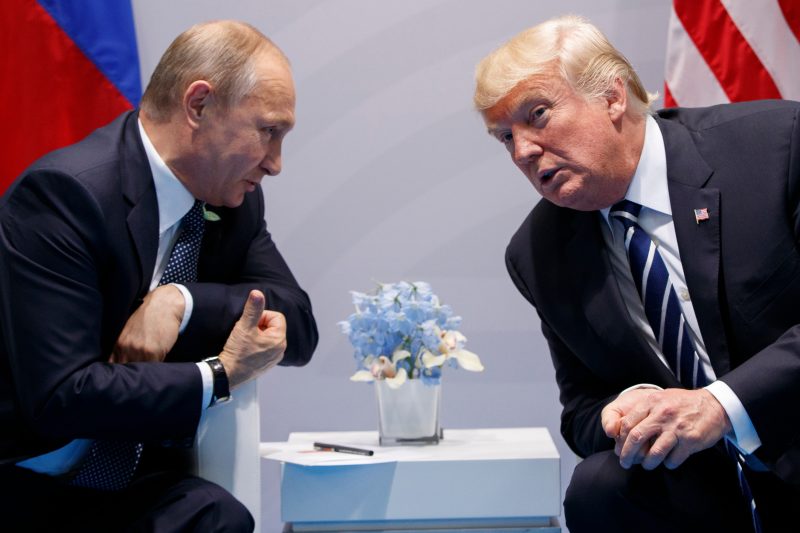
Where the Russians got lucky was in Trump’s response to the 2016 effort. His sympathy for Russia and for Russian President Vladimir Putin was obvious well before Election Day that year. (In retrospect, it’s probably not a coincidence that Russia’s efforts in 2014 followed surprisingly sympathetic responses from prominent Republicans after Russia’s initial Ukraine incursion that year.) It was Trump’s vanity, though, that proved most useful to the Russians.
In the weeks after the election, reporting slowly began to detail what Russia had been up to. Having won the electoral vote but lost the popular vote, Trump was sensitive about any suggestion that his victory wasn’t a mandate proving his popularity. So he forcefully rejected the idea that Russia had aided his campaign, though reporting (and common sense) suggested that this had become one of the country’s aims. He even repeatedly rejected the idea that Russia had tried to interfere in the election at all.
The issue lingered because of a federal investigation seeking to determine whether people on Trump’s campaign or the candidate himself had worked with the Russian actors. Some had: His son and campaign chairman met with a Russian attorney who promised dirt on Trump’s opponent; that same campaign manager later passed internal polling data to a person linked by a bipartisan Senate investigation to Russian intelligence. It also documented the breadth of Russia’s influence effort, including that trip taken by Krylova and Bogacheva a decade ago. But the investigation was ultimately unable to prove direct coordination between Trump and Russian actors.
Trump proclaimed this to be a complete exoneration, proof that (as he had claimed since early 2017) the Russia probe was “a hoax.” Over the years, he and his allies responded to any report about Russia’s efforts with this same simplistic rejoinder: All that Russia stuff was a hoax! This narrative was helped by occasions on which commentators on the left embraced dubious or debunked claims (like that there was a nefarious connection between Trump’s company and a Russian bank, which there wasn’t). But it was more broadly a catchall aimed at waving away any claim about Russian activity as a Democratic fever dream.
The new indictment reinforces that it wasn’t. Russia began trying to influence American politics a decade ago, ultimately finding a sympathetic ally in Trump. Now, instead of trying to make fake personalities who can elevate contentious issues to Russia’s benefit, there’s a stable of Trump-allied voices who already are.
It’s useful to note, too, that Russia’s efforts to move the needle are often even less subtle. On Thursday, apparently in response to the new indictments, Putin announced his endorsement of … Vice President Kamala Harris.