
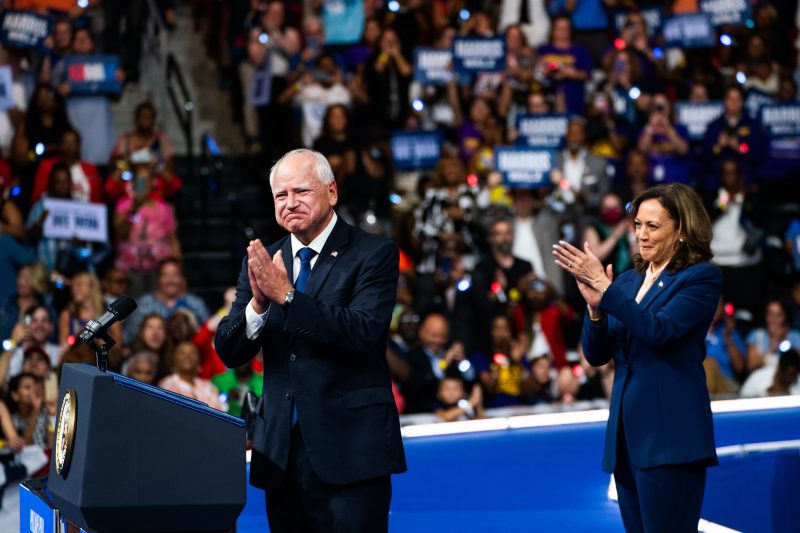
Minnesota Gov. Tim Walz, the Democrats’ recently selected vice-presidential nominee, owns no businesses, individual stocks, a home or other real estate — a modest financial position that may put him on par with other former high school teachers but creates a striking contrast with the Republican nominee for vice president, Sen. JD Vance (Ohio).
The financial disclosure form Walz filed with the state of Minnesota this year is nearly blank, listing no assets other than income from his government job and his wife’s work in education. Gwen Walz, a career teacher, has held several positions in recent years at Augsburg University in Minneapolis.
The couple earned a combined income of a little over $166,000 in 2022, according to their tax return, including Walz’s $115,485 annual salary as governor.
As vice president, Walz would earn a salary of $284,600, a major pay raise.
The Walzes sold their home in Mankato, Minn., after he became governor in 2019, according to real estate records. Then they moved into the Minnesota Governor’s Residence in St. Paul and are presently living in what is normally the University of Minnesota’s president’s house while the governor’s residence is being remodeled.
He is among the less wealthy candidates to run for vice president, said American University history professor Allan Lichtman, but not completely out of the ordinary historically. Hubert Humphrey, a college professor and radio commentator turned career politician, was not a wealthy man when he became vice president under Lyndon B. Johnson in 1965, Lichtman said.
On the other end of the spectrum, Dick Cheney was serving as chief executive of energy giant Halliburton when he was chosen as George W. Bush’s running mate for the 2000 election, and he had an estimated net worth of well over $50 million when he took office. John Edwards, who had worked as a trial lawyer in North Carolina before his election to the Senate in 1998, reported a net worth between $12 million and $60 million before he became John F. Kerry’s running mate in 2004.
Walz’s financial portfolio makes him by far the least wealthy candidate on either major party ticket this year — in part because, unlike many past candidates for national office, he is not a lawyer and did not write a best-selling book.
Vice President Kamala Harris, the Democratic presidential nominee, disclosed tax returns during her 2020 presidential run showing that she and husband Doug Emhoff, both attorneys, reported a combined income of more than $1.8 million in 2018. Forbes has pegged their net worth at around $8 million. Former president and Republican presidential nominee Donald Trump has built his image around his success in real estate and branding.
Walz has sought to create a contrast between his own choices and those of Vance, who — as Walz has pointed out — chose to attend Yale University and work in Silicon Valley.
Spokespeople for Vance and Walz did not respond to requests for comment.
Vance grew up poor in Southern Ohio but vaulted to fame with the best-selling book he wrote about his childhood, “Hillbilly Elegy,” and a Netflix movie based on the book, directed by Ron Howard. He also worked as a public speaker and at venture capital firms before he was elected as a U.S. senator in 2022.
On the 2022 personal financial disclosure form he filed as senator, Vance reported owning more than 150 assets, including many investments in start-up companies. Altogether, the assets were worth a total of between around $4.3 million and $10.8 million, according to an analysis by The Washington Post. He also reported investment income of around $1 million in 2022, according to the form.
Vance and his wife, Usha, who met at Yale Law School, own a home in Northern Virginia that they purchased last year for $1.6 million, according to real estate records. They reported owning a D.C. townhouse that they rented out for between $15,000 and $50,000 in 2022.
Though his book was published in 2016, Vance reported earning more than $121,000 in royalties from sales of “Hillbilly Elegy” in 2022 — more than Walz’s salary as governor that year. The book rocketed back to the bestsellers list in recent weeks following Vance’s selection as Trump’s running mate.
Vance made dozens of investments in start-ups during short stints at venture capital posts: first at Silicon Valley-based Mithril Capital Management, Republican donor Peter Thiel’s firm, and then D.C.-based Revolution.
Vance started his own investment firm, Narya Capital Management, in 2019 upon returning to Ohio. He received a salary of $110,000 from the company in 2022, the year he won a seat in the Senate, putting his total noninvestment income for that year at over $230,000.
“That’s not exceptionally wealthy today,” Lichtman said. “That might have been exceptionally wealthy in the 50s, but it’s a more moderate level of wealth today.”
Walz stands out among Democratic candidates for vice presidency in recent memory in that many of them, including Harris, Edwards, Joe Biden, Tim Kaine and Al Gore, were both lawyers and U.S. senators.
Biden and Kaine each had a net worth of under $1 million when they ran for vice president.
Senators — including those running for vice president — have been trending wealthier in recent decades, said Don Ritchie, historian emeritus of the U.S. Senate.
“Back in the old days, senators were working their way up,” Ritchie said. “Today, for the most part, senators are fairly well-off. They have to be to run for office these days. They come to office with a healthy portfolio.”